
Last Updated: October 25, 2026
Quick Summary
The biggest factor in flower longevity is a clean vase and sharp, angled cuts, not the flower itself. Change the water every two days, re-cut stems at 45 degrees, and keep arrangements cool and away from sunlight, heat and ripening fruit. Most cut flowers last five to seven days with good care.
- Scrub the vase with hot water and dish soap before every bouquet, since bacteria shortens vase life fast.
- Strip all leaves that would sit below the waterline, because submerged foliage rots and spreads bacteria.
- Commercial flower food contains sugar, an acidifier and a biocide; follow the packet dose exactly rather than doubling it.
- Ripening fruit releases ethylene gas, so keep bouquets away from the fruit bowl.
- Carnations and mums last 7 to 14 days, while hydrangeas and delicate blooms last only 3 to 5.
Table of Contents
- Start With a Clean Vase and Sharp Snips
- How to Trim Flower Stems for Better Water Uptake
- How Often to Change Flower Water (and Why It Matters)
- Flower Food and DIY Additives: What Works and What Doesn't
- Placement Rules: Cool Spots, No Sun, No Fruit
- How to Make Flowers Last Longer by Flower Type
- How Long Do Cut Flowers Last? Realistic Expectations
- Troubleshooting Wilting Blooms by Symptom
- Frequently Asked Questions
Start With a Clean Vase and Sharp Snips
The single biggest factor in flower longevity is not the flower itself. It's what you put it in. A dirty vase and a dull pair of snips undo every other good habit you'll build, and most people skip both steps without thinking. This guide covers the nine habits that actually move the needle on flower longevity, from the first cut to the last petal. Below, we'll show you exactly what to do and why each step matters.
Wash the Vase Like You Mean It
A rinse is not enough. Vases collect a thin film of bacteria after every use, and that film feeds on stem tissue the moment water goes in.
- Scrub the inside walls with hot water and a drop of dish soap
- Use a bottle brush to reach the bottom and shoulder
- Rinse twice with clean water
- Let it air-dry upside down before the next bouquet
Watch out: skipping the scrub is the most common cause of cloudy water within two days. Cloudy water means bacteria, and bacteria shortens vase life fast.
Strip Every Leaf Below the Waterline
Submerged foliage is a hidden killer. Leaves left underwater rot, and rot spreads bacteria through the whole vase.
Strip leaves from the bottom third of every stem before you place the bouquet. Work over a bin, not the sink, so you don't clog the drain. Any leaf that would sit below the rim of the vase has to go.
How to Trim Flower Stems for Better Water Uptake
Cut stems at a 45-degree angle with sharp floral shears or a clean knife. An angled cut keeps the stem from resting flat on the vase bottom, which lets water flow up the stem instead of sealing it off. Do this every time you change the water, not just once.
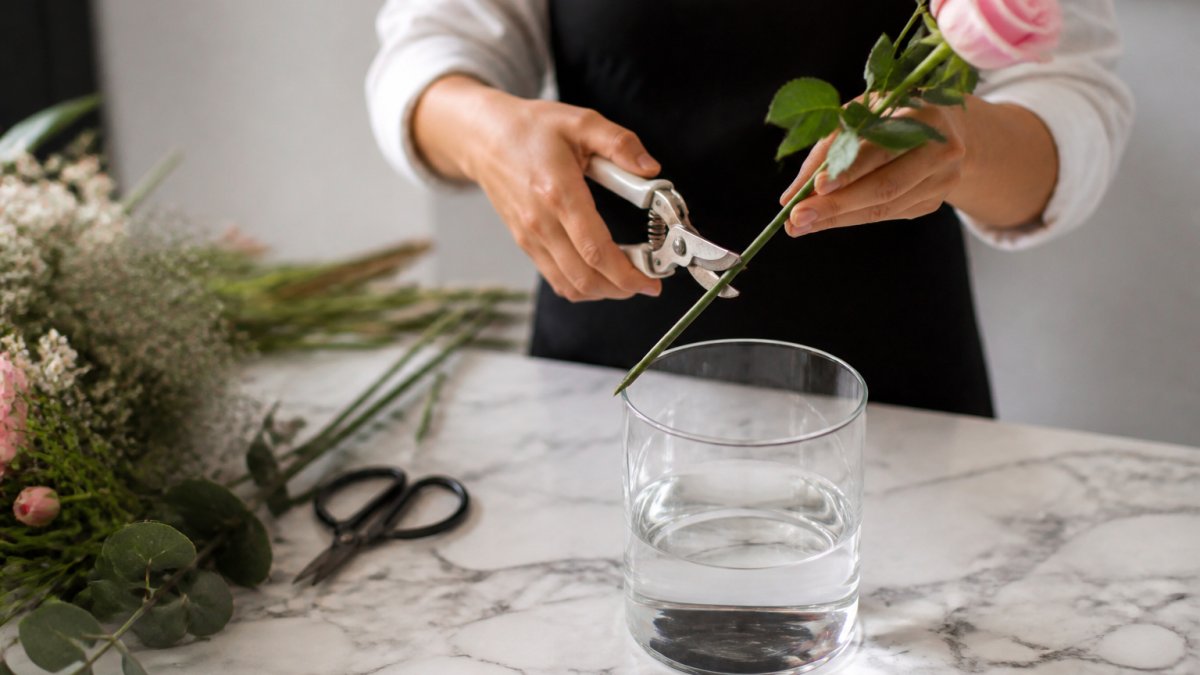
Follow these steps:
- Fill a basin with cool water and cut stems while submerged if you can
- Remove at least one centimeter from the bottom
- Cut at 45 degrees, never straight across
- Use a sharp blade, not scissors that crush the stem
- Re-cut every two to three days
Crushed stems can't drink. That's why kitchen scissors are a poor substitute for proper shears.
How Often to Change Flower Water (and Why It Matters)
Change the water every two days, and every day in warm weather. Fresh water does two jobs: it replaces what the flowers drank, and it removes the bacteria that build up in standing water. How often to change flower water depends on the arrangement, but two days is a safe default for most bouquets.
The routine is simple:
- Empty the vase completely, don't just top it up
- Rinse the vase
- Re-cut the stems
- Refill with cool water
- Add flower food if you use it
Topping up old water is the mistake nobody talks about. You're just adding clean water to a bacterial soup.
Flower Food and DIY Additives: What Works and What Doesn't
Commercial flower food is the only additive with a formulated, balanced purpose.
Home remedies circulate widely, so it helps to separate the ones with a plausible mechanism from the ones that are folklore.
| Additive | Mechanism | Practical verdict |
|---|---|---|
| Commercial flower food | Sugar + acidifier + biocide | Best all-in-one option; follow packet dosing exactly |
| A few drops of household bleach | Oxidizes bacteria | Works only at very low concentration (roughly a few drops per liter); easy to overdo and burn stems or petals |
| Sugar alone | Feeds stems but also feeds bacteria | Not recommended without a biocide; can accelerate cloudy water |
| Lemon juice or vinegar | Lowers pH | Mild benefit when paired with sugar; not a substitute for flower food |
| Aspirin (acetylsalicylic acid) | No reliable cut-flower mechanism | Folk remedy; skip |
| Copper penny | Trace copper has some antimicrobial effect in theory | Unreliable in practice; modern pennies are mostly zinc, and dosing is guesswork |
| Vodka or mouthwash | Alcohol or antiseptic | Can help at very low doses but risks phytotoxicity; not a controlled method |
| Sprite or 7-Up | Sugar + acid | Feeds bacteria as much as flowers; not recommended |
A practical middle path for people who want a DIY option: use the commercial food if you have it, and if you don't, change the water every day and re-cut stems every two days. Fresh water and a clean vase outperform almost any kitchen recipe. If you are conditioning stems after transport, a commercial food sachet plus cool water is the most reliable combination.
One more note on water temperature: most cut stems take up cool water (roughly 15-20°C) more readily than warm water, and warm water encourages bacterial growth. The exception is woody or sap-heavy stems, which sometimes benefit from a brief warm-water conditioning before moving to a cool vase. When in doubt, cool water and a clean vase are the safer default.
Placement Rules: Cool Spots, No Sun, No Fruit
Keep arrangements away from direct sunlight, heat sources, and ripening fruit. Flowers last longest in a cool location with steady room temperature and good air flow. This one rule protects every bouquet you bring home.
Here's why fruit matters. Ripening fruit releases ethylene gas, and ethylene speeds up aging in cut flowers. A bowl of bananas next to your bouquet will shorten its life. Move the fruit, or move the flowers. Once the inevitable decay of your arrangement finally sets in, you might consider preserving flowers in resin to capture their beauty indefinitely.
- Keep vases off radiators and out of sunny windows
- Avoid spots near stoves, ovens, or vents
- Skip the fruit bowl shelf
- Move arrangements to a cooler room overnight in hot weather
If you're planning where a bouquet will live long term, our guide to long lasting flowers for home decor covers placement and styling in more detail.
How to Make Flowers Last Longer by Flower Type
Treating every stem the same is the most common reason a mixed bouquet fades unevenly.
Roses. Roses seal at the cut end quickly, so re-cut at a 45-degree angle every two days and use cool water. Remove guard petals as they brown, and strip all foliage that would sit below the waterline. If a rose head droops while the stem is still firm, the stem is likely air-blocked: re-cut under water and stand the stem in cool water for an hour.
Tulips. Tulips continue to grow in the vase and can add several centimeters, so give them a taller vase and cool water.
Hydrangeas. Hydrangeas are the thirstiest common cut flower and wilt dramatically when they cannot keep up.
Lilies. Remove the pollen-covered anthers as soon as the bud opens, pollen stains petals and fabric and is difficult to remove once it sets.
Orchids. Cut orchids are slow agers.
Carnations and mums. These are the toughest common stems and tolerate more variation, but they are sensitive to bacteria.
Delicate blooms (sweet peas, ranunculus, anemones). These need cooler water, gentler handling, and shallower vases. Handle stems by the base, not the bloom, and change water daily.
A simple rule for mixed bouquets: condition the thirstiest stems (hydrangea, delicate blooms) first, give them the coolest spot, and accept that the toughest stems (carnations, mums) will outlast the rest.
How Long Do Cut Flowers Last? Realistic Expectations
Most cut flowers last five to seven days with good care. Some last longer, some much less. Setting a realistic expectation protects you from disappointment and helps you plan replacements.
Here's a rough guide:
| Flower type | Typical vase life with good care |
|---|---|
| Carnations and mums | 7 to 14 days |
| Roses | 5 to 7 days |
| Tulips | 4 to 7 days |
| Lilies | 5 to 10 days |
| Hydrangeas | 3 to 5 days |
| Delicate blooms | 3 to 5 days |
If you want flowers that last far longer than a week, preserved arrangements are worth a look. Our article on why preserved flowers last longer explains the process, and you can browse long lasting flower boxes if you'd rather skip the weekly water change entirely.
Troubleshooting Wilting Blooms by Symptom
Match the symptom to the fix. Wilting blooms usually point to one of a few specific problems, and the cure is different for each.
- Drooping heads, limp stems: Stems aren't drinking. Re-cut at an angle and refresh water.
- Cloudy water: Bacteria bloom. Empty, scrub the vase, and re-cut.
- Yellow leaves above the waterline: Old foliage. Strip it and check for rot below.
- Brown, crispy petal edges: Heat or sun damage. Move to a cooler spot.
- Foul smell: Rotting submerged foliage. Clean the vase and strip leaves.
- Hydrangea collapse: Thirst. Mist petals and submerge the stem ends in cool water.
If a bouquet is past saving, a fresh replacement is the honest fix. Our designer's choice bouquet is built from seasonal stems and makes an easy swap. And if you're ordering a new delivery, our guide on how to ensure quality flower delivery helps you get blooms that arrive in good shape.

When you order from us, we deliver across Montreal, Westmount, TMR, Hampstead, and Laval, so a fresh arrangement is never far away.
Frequently Asked Questions
How do you make fresh flowers last longer?
Start with a clean vase and recut each stem at a 45-degree angle before arranging. Change the water every two days, add commercial flower food, and strip any leaves sitting below the waterline. Keep the arrangement out of direct sunlight and away from heat sources, radiators, and fruit bowls. A cool spot and consistent water changes are the two habits that extend flower longevity the most.
How often should you change the water in a flower vase?
Change the water every two days, or daily in warm weather. Empty the vase completely, rinse it, and refill with fresh room-temperature water. Recut the stems by a centimetre or two at the same time so the fresh cut can take up water. Cloudy water or a slippery vase wall means bacteria have built up and the change is overdue.
What can you add to vase water to keep flowers fresh?
Commercial floral preservative is the most reliable option: it supplies sugar for energy and an acidifier that slows bacterial growth. Household remedies like aspirin, pennies, or sugar alone are inconsistent and can feed bacteria. If you have no flower food, a quarter teaspoon of bleach in a litre of water slows bacterial growth, but commercial preservative remains the safer choice for delicate blooms.
Why are my fresh flowers wilting so quickly?
The usual causes are bacteria in the water, stems that were not recut, or leaves submerged below the waterline. Heat, direct sunlight, and ethylene from nearby fruit also shorten flower longevity. Recut the stems, strip submerged foliage, scrub the vase, and move the arrangement to a cool spot. If only some blooms wilt, remove them so they do not spread bacteria to the rest of the bouquet.
Nine habits, one goal: flowers that stay beautiful longer than you expect. If you'd rather skip the daily fuss, Luluthia Design Inc offers preserved arrangements and signature flower boxes that hold their look for far longer than fresh stems. Our team designs each piece by hand, with customizable options and convenient online ordering. Get started with Luluthia Design Inc and bring home floral art that keeps its beauty.
