
Last Updated: November 15, 2026
Quick Summary
Style large succulents in modern offices by placing one bold specimen as a focal point, then grouping it with mid-height and low plants for contrast. Choose slow-growing types matched to the mature space, set them in stable planters with drainage, and position them in bright, indirect light near glazing.
- One large plant reads better than five small ones in open-plan offices.
- Allow the plant's mature spread plus a hand's width of clearance on each side.
- Water only when soil is fully dry, roughly every two to three weeks.
- South and west windows give the strongest light; watch for harsh afternoon sun.
- Set grow light timers for 10 to 12 hours a day rather than continuous use.
Table of Contents
- Why Large Succulents Belong in Modern Office Design
- Choosing the Best Succulents for Offices
- Selecting Modern Office Planters That Support Scale
- Assessing Light and Window Placement in Office Zones
- Arranging Large Succulents with Height and Visual Contrast
- Indoor Succulent Care: Watering, Soil, and Drainage
- Safety and Accessibility in Shared Workspaces
- Ordering a Statement Succulent for Your Office
- Frequently Asked Questions
Why Large Succulents Belong in Modern Office Design
Large succulents solve a problem most office plants cannot: they bring sculptural presence without demanding daily attention. Large succulents work hardest in open-plan spaces where a single bold plant has to hold a room together. Styling tips for large succulent plants in modern offices start with understanding what these plants actually do for a space.
They add height where desks and screens flatten a room. They create a natural focal point without the fuss of fresh flowers. And they keep looking good through long weekends and holiday closures.
- Scale: one large plant reads better than five small ones
- Texture: sculptural forms soften glass and steel
- Low-maintenance: ideal for shared, busy workplaces
- Longevity: slow growth means the look lasts for years
Modern office design leans on greenery to make hard surfaces feel human. A large succulent does that job with quiet confidence.
Choosing the Best Succulents for Offices
The best succulents for offices are slow-growing, tolerant of dry air, and happy in bright indirect light. Size matters as much as species. A plant that stays compact will never anchor a corner, so choose by mature silhouette and eventual dimensions rather than by the size on the nursery shelf.
Here is how we group large specimens for workplace use, with the mature sizes most commonly cited for each type:
- Statement rosettes: wide, sculptural, and dramatic at full size. Agave americana and its variegated forms can spread well over a metre across, while Agave attenuata stays softer and spineless, which suits reception areas where people brush past. Echeveria and Aeonium species stay smaller and work better as supporting plants than as the anchor.
- Columnar types: tall and architectural, good for narrow spots. Euphorbia trigona and Euphorbia ingens can reach 1.5 to 2 metres indoors over many years, giving real height without a wide footprint. Sansevieria, often sold as a succulent, holds upright sword-shaped leaves at 60 to 120 cm and tolerates lower light than most true succulents.
- Cacti: upright and structural, excellent for height variation. Cereus and Trichocereus types grow columnar and can exceed a metre, but their spines make placement a safety decision as much as a design one. Keep them out of walkways and away from seated eye level.
- Clustering varieties: fill lower planters and add texture. Aloe arborescens and Crassula ovata branch into shrubby forms that read as a mid-height mass rather than a single rosette, which helps bridge tall specimens and low fillers.
For deeper guidance on matching plants to a workplace, see which flowers suit a corporate office best.
Mature Dimensions and Growth Rates
Check the mature size before you buy, not after. A plant sold at 20 cm may reach well over a metre in the right conditions, and a wide rosette can outgrow a reception console within a few years.
A practical rule is to allow the plant's mature spread plus a hand's width of clearance on each side, so leaves do not press against glass, partitions, or passing shoulders. Columnar types need less floor area but more headroom; rosettes need more floor area but less height. Record both dimensions before you commit to a spot.
Watch out: a plant labeled "large" at purchase may be a fast-growing species that quickly outgrows a desk-side planter, while a genuinely slow specimen may look undersized for a year before it fills out. Confirm the species and its growth habit rather than trusting the pot size alone.
Here is how we group large specimens for workplace use, with the mature sizes most commonly cited for each type.
| Type | Examples | Mature size | Best for |
|---|---|---|---|
| Statement rosettes | Agave americana, Agave attenuata | Well over a metre across | Reception areas, dramatic focal points |
| Columnar types | Euphorbia trigona, Euphorbia ingens | 1.5 to 2 metres indoors | Narrow spots needing height |
| Upright sword leaves | Sansevieria | 60 to 120 cm | Lower light than most true succulents |
| Cacti | Cereus, Trichocereus | Can exceed a metre | Height variation, away from walkways |
| Clustering varieties | Aloe arborescens, Crassula ovata | Shrubby mid-height mass | Bridging tall specimens and low fillers |
Selecting Modern Office Planters That Support Scale
A large succulent needs a planter that matches its weight and presence. Flimsy pots tip, crack, or look out of place beside heavy furniture. Choose planters with a wide, stable base and a drainage hole.
Material choices that suit modern offices:
- Matte ceramic: quiet, elegant, and heavy enough to stay put
- Concrete or stone composite: industrial and grounding
- Powder-coated metal: slim and contemporary
- Fibreglass: lighter for large sizes, easier to move
Pot size should leave a few centimetres of room around the root ball, no more. Oversized pots hold excess soil that stays wet too long. For a sense of how professional styling lifts a workplace, browse our corporate floral arrangements for offices.
Assessing Light and Window Placement in Office Zones
Light decides where a large succulent can live. Most succulents want bright, indirect sunlight for several hours a day. A desk deep in an open-plan office rarely offers that, so assess each zone before you place a plant rather than after it starts to stretch.
Walk your space and note:
- South and west windows: strongest light, watch for harsh afternoon sun
- East windows: gentle morning light, ideal for most succulents
- North windows: low light, best suited to tolerant varieties
- Interior zones: need grow lights to thrive
A Simple Method for Measuring Office Light
Rather than guessing from window direction alone, measure the light where the plant will actually sit. A free light-meter app on a phone gives a workable relative reading; take it at midday and again in mid-afternoon, at the height of the plant's crown, not at floor level. Compare the readings across the zones you are considering and rank them.
Distance from glass matters more than most people expect. Light falls off quickly as you move into the room, so a spot two metres from a window may receive a fraction of what the same spot at the glass receives.
Seasonal change is the other variable. In winter, low sun angles and shorter days reduce light in north-facing and interior zones, and a plant that looked healthy in summer may begin to pale or stretch by February. Note how the light shifts across the year and plan to supplement in the darker months.
Grow Lights for Low-Light Zones
For offices with little natural light, a simple LED grow light on a timer keeps plants healthy. Full-spectrum LED bars and clip-on lamps are widely available, and a timer set for 10 to 12 hours a day is a common starting point. Place the light above the plant's crown rather than to one side, and keep it close enough to be effective without scorching leaves. For a large rosette, a single bar may not cover the full spread, so consider two lights or a panel sized to the plant.
Window placement near glass can overheat plants in summer. Pull pots back slightly and rotate them monthly for even growth, since a plant that never turns will lean toward the light and lose its silhouette.
Watch out: a grow light left on continuously can disrupt a plant's rest cycle and waste energy; use a timer rather than leaving it on around the clock.
Arranging Large Succulents with Height and Visual Contrast
Grouping is where styling becomes design. A single large succulent anchors the composition. Lower plants around it add shape and texture contrast.
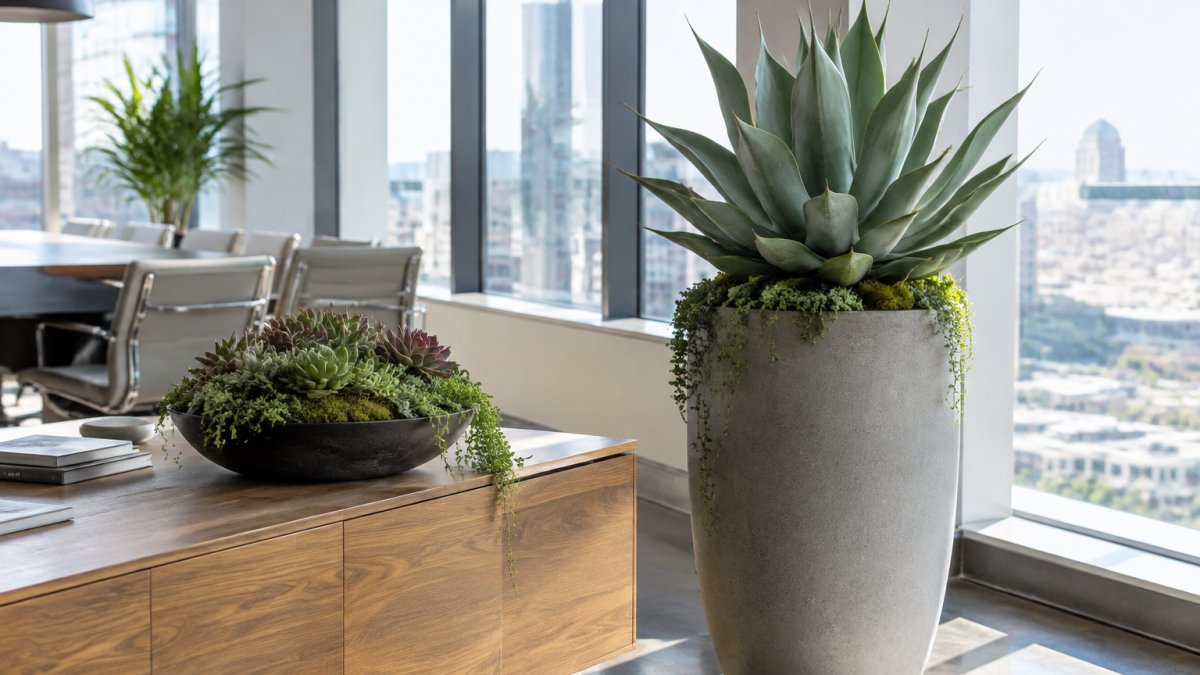
Follow these steps:
- Place the tallest plant first as your focal point.
- Add a mid-height plant to one side, never dead center.
- Fill the base with low, compact varieties.
- Mix shapes: round rosettes against upright columns.
- Leave negative space so each plant reads clearly.
- Repeat the grouping in a second zone for rhythm.
Height variation creates visual contrast. Shape and texture do the rest. For inspiration on scale and drama, our luxury floral arrangements for corporate events show how height transforms a room.
Indoor Succulent Care: Watering, Soil, and Drainage
Indoor succulent care comes down to three things: water sparingly, use well-draining soil, and never let roots sit in water. Overwatering is the most common mistake we see.
- Water only when the soil is fully dry, roughly every two to three weeks.
- Use a potting mix made for cacti and succulents.
- Always choose pots with drainage holes.
- Empty saucers and trays after watering.
- Cut back watering in winter when growth slows.
Watch out: watering on a fixed weekly schedule kills more succulents than neglect does. Feel the soil first.
Safety and Accessibility in Shared Workspaces
Shared offices need plants that do not create hazards. Large planters are heavy, so place them where people will not trip or bump into them. Keep them out of main walkways and away from emergency exits.
- Use stable, weighted planters in high-traffic areas.
- Keep spined cacti out of reach in shared zones.
- Position plants so they do not block sightlines or signage.
- Check that pots sit level on carpet and hard floors.
Accessibility matters too. Leave clear paths around every planter for wheelchairs and carts. A beautiful plant should never get in the way of how a space works.
Ordering a Statement Succulent for Your Office
Our extra large succulent is a bold, low-maintenance plant for a workplace space.
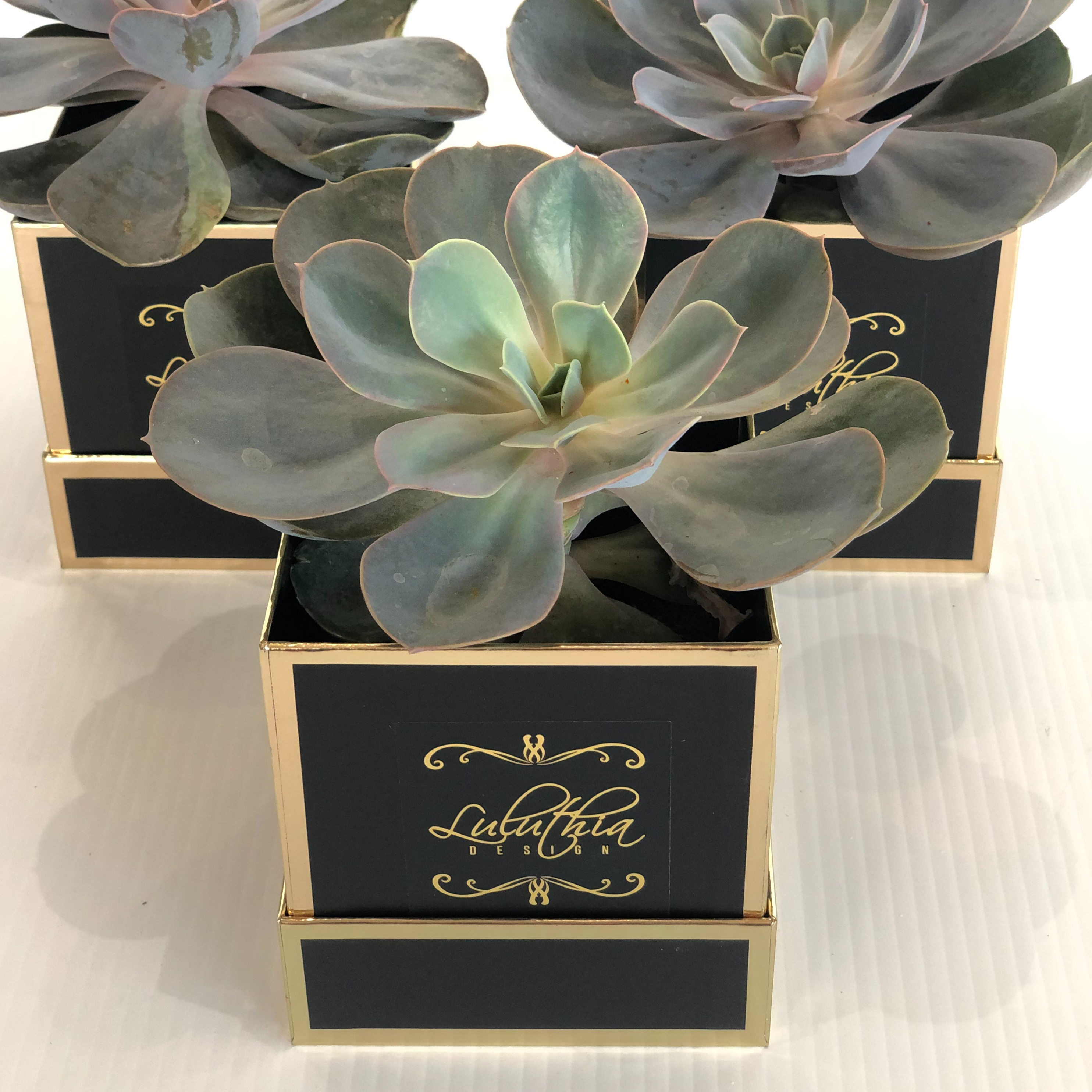
Before you order, measure the spot and confirm the light. Then choose a planter with a stable base and drainage. One well-placed large succulent will do more for a room than a shelf of small pots.
Styling a modern office around greenery takes an eye for scale, light, and proportion. Luluthia Design Inc brings that eye to every arrangement, with full-service design, fresh and preserved collections, and delivery across the region. Our team helps you choose plants and florals that suit your space and your brand. Get started with Luluthia Design Inc and give your workplace a focal point that lasts.
Frequently Asked Questions
How do you style large succulent plants in an office?
Start with the room's architecture: place a large succulent where it anchors a sightline, such as beside a meeting room entrance or at the end of a long desk run. Group it with two or three smaller succulents at different heights to create visual contrast. Choose a planter that matches the office palette and is heavy enough to stay stable. Keep the arrangement low-maintenance by selecting slow-growing species and positioning the group near natural light.
Which large succulents work well in modern offices?
Look for sculptural, slow-growing types that tolerate indoor conditions. Columnar cacti, upright euphorbia, and rosette-forming succulents with thick leaves all hold their shape in low-humidity office air. Avoid fast-spreading varieties that outgrow a planter within a season. Check the mature height before buying: a plant that reaches 90 cm or more needs floor space and a stable pot. The Luluthia Succulent Extra Large is available for $48.00 CAD.
How much light do office succulents need?
Most large succulents want bright, indirect light for at least four to six hours a day. Place them within two metres of a south- or west-facing window where possible. In low-light offices, add a full-spectrum grow light on a timer for eight to ten hours daily. Rotate the pot a quarter turn every two weeks so growth stays even. If the plant starts stretching or losing color, it is asking for more light.
Can large succulents thrive in an office with low natural light?
Yes, with support. Choose shade-tolerant species such as snake plant relatives or certain haworthia, and supplement with a grow light. Keep the plant away from air-conditioning vents, which dry the leaves. Water sparingly, roughly every three to four weeks, and let the soil dry completely between waterings. A light meter reading below 100 foot-candles means the spot needs artificial help for long-term health.
