
Quick Summary
Preserved flowers can be safe for pets, but it depends on two things: whether the original plant species is toxic, and whether the preservation treatment, such as glycerin, dyes or finishing sprays, is pet-safe. Check the species name and ask the seller how the flowers were preserved before bringing preserved flowers pets might reach home.
- Preservation does not remove a plant's toxicity, so check the species name first.
- Preserved flowers add a treatment risk that fresh and dried flowers do not have.
- Ask sellers for the botanical names, preservation method and any dyes or sprays used.
- Keep any arrangement out of reach until the species and treatment are confirmed.
- If a pet eats a flower, remove the plant and call your veterinarian promptly.
Table of Contents
- Why Preserved Flowers Raise Different Safety Questions Than Fresh Ones
- Preserved, Dried and Fresh Flowers: How Each Affects Pet Safety
- Are Dried Flowers Toxic to Cats, and What About Dogs?
- Flowers Toxic to Cats and Flowers Safe for Dogs: A Species Guide
- Checking Preservatives, Dyes and Product Labels
- What to Do if a Pet Eats or Chews a Flower
- Keeping Your Pet Safe Around Your Arrangements at Home
- Choosing a Pet-Conscious Arrangement for Your Home
- Frequently Asked Questions
How to Tell If Preserved Flowers Are Safe for Pets
Last Updated: November 2, 2026
Why Preserved Flowers Raise Different Safety Questions Than Fresh Ones
Are preserved flowers safe for pets? It's a fair question, and the honest answer is that it depends on how the flowers were made, what they're made of, and what your pet is likely to do with them.
Preserved flowers are real blooms that have been treated to last. That treatment changes what's in the petals, so safety for preserved flowers pets can't be judged the same way as a fresh bouquet.
Fresh flowers come with a long list of known plant species to check. Preserved flowers add a second layer: the preservation process itself.
Preserved, Dried and Fresh Flowers: How Each Affects Pet Safety
These three terms get used interchangeably, but they describe different products with different risk profiles. The distinction matters because the keyword is about preserved flowers specifically, and most general pet-safe flower lists do not separate them.
Fresh flowers are cut stems kept in water. The risk comes almost entirely from the plant species: pollen, sap, leaves, and stems. A lily is dangerous fresh, and the danger is in the plant itself.
Dried flowers have had moisture removed by air-drying, pressing, or silica. The species does not change, so a toxic plant stays toxic after drying. What changes is the physical form: dried petals and seed heads shatter easily, drift to the floor, and are more likely to be batted, chewed, or swallowed by cats and dogs.
Preserved flowers are real blooms treated to keep their softness and color for months or longer. That is the key difference: with preserved flowers, safety depends on two variables, not one.
- Species risk: the original plant's toxicity does not disappear during preservation. A toxic species remains a concern.
- Treatment risk: glycerin, dyes, and finishing sprays are not automatically pet-safe, and the risk depends on concentration, formulation, and how much a pet ingests or chews.
A useful way to think about it:
| Type | Species risk | Added treatment risk | Physical shedding risk |
|---|---|---|---|
| Fresh | Yes | Minimal | Low |
| Dried | Yes | Low, but dust and mold possible | High |
| Preserved | Yes | Yes, depends on product | Moderate |
A safe species preserved with a simple glycerin solution is a very different product from an unknown mixed arrangement with undisclosed dyes and sprays. Neither is automatically safe or unsafe; the point is that preserved flowers require you to ask about the process, not just the plant. Understanding the specific treatment methods applied to your arrangement is essential for managing expectations regarding preserved flower longevity.
Are Dried Flowers Toxic to Cats, and What About Dogs?
Dried flowers follow the same rule as fresh ones: the plant species decides the risk. If a flower is toxic to cats when fresh, drying it does not remove that toxicity. Many owners assume drying makes a plant harmless, and that assumption is often wrong.
Cats and dogs have different sensitivities.
A safe rule of thumb: check the species name on every dried or preserved item before bringing it home.
Flowers Toxic to Cats and Flowers Safe for Dogs: A Species Guide
Knowing which plants are risky helps you choose wisely. Lilies, for example, are among the most dangerous flowers for cats, even in small amounts. Many common bouquet flowers, such as tulips and daffodils, can also cause problems for pets.
Always confirm with a veterinarian or a trusted pet-poison resource for your specific pet.
Common Flowers Safe for Dogs
- Roses
- Sunflowers
- Orchids
- Lavender (in small amounts, as leaves and flowers can still upset some pets)
- Statice
- Zinnias
Checking Preservatives, Dyes and Product Labels
Questions worth asking a seller:
- Which flower species and greenery are in the arrangement? Ask for the common and botanical name, because "mixed seasonal" tells you nothing about toxicity.
- What preservation method was used? Glycerin replacement, silica drying, and air-drying carry different residue profiles.
- Were dyes, bleaches, or finishing sprays applied? Ask whether they are surface-applied or absorbed into the plant.
- Is any part of the product described as pet-safe, and by what standard? A vague "non-toxic" claim is weaker than a specific ingredient list.
- Are wire, foam, tape, or adhesive used in the construction? These matter as much as the flowers for chewing and obstruction risk.
How to interpret the answers:
- A clear species list plus a simple glycerin method is easier to assess than an unnamed mix.
- "Preserved" on its own is a process description, not a safety claim.
- If the seller cannot identify the species or the treatment, treat the arrangement as unknown rather than assuming it is safe.
- A product marketed as decorative rather than edible has not been evaluated for ingestion, even if the flowers are a non-toxic species.
If the ingredients are undisclosed:
- Keep the arrangement out of reach until you can confirm the species and treatment.
- Contact the seller in writing so you have a record of what they state.
- If the arrangement is already accessible to a pet and you are unsure, treat it as a potential exposure and follow the response steps below.
- Choose a replacement product from a seller who lists species and materials, so the next decision is based on information rather than assumption.
A label check takes a few minutes and is the single most useful habit for anyone buying preserved flowers for a pet-owning household.
What to Do if a Pet Eats or Chews a Flower
Act quickly and calmly. Follow these steps:
- Remove the plant. Take away any remaining pieces so your pet cannot chew more.
- Identify the plant. Bring the species name or a photo to your vet or poison hotline.
- Note the amount and time. Record how much was eaten and when.
- Watch for symptoms. Vomiting, drooling, diarrhea, lethargy, or irritation around the mouth are signs to take seriously.
- Call your veterinarian. Do not wait for symptoms to get worse. Early advice makes a real difference.
Do not induce vomiting unless a veterinarian tells you to do so.
Keeping Your Pet Safe Around Your Arrangements at Home
Placement matters as much as the flower choice. Keep arrangements on high shelves or in rooms your pet cannot enter.
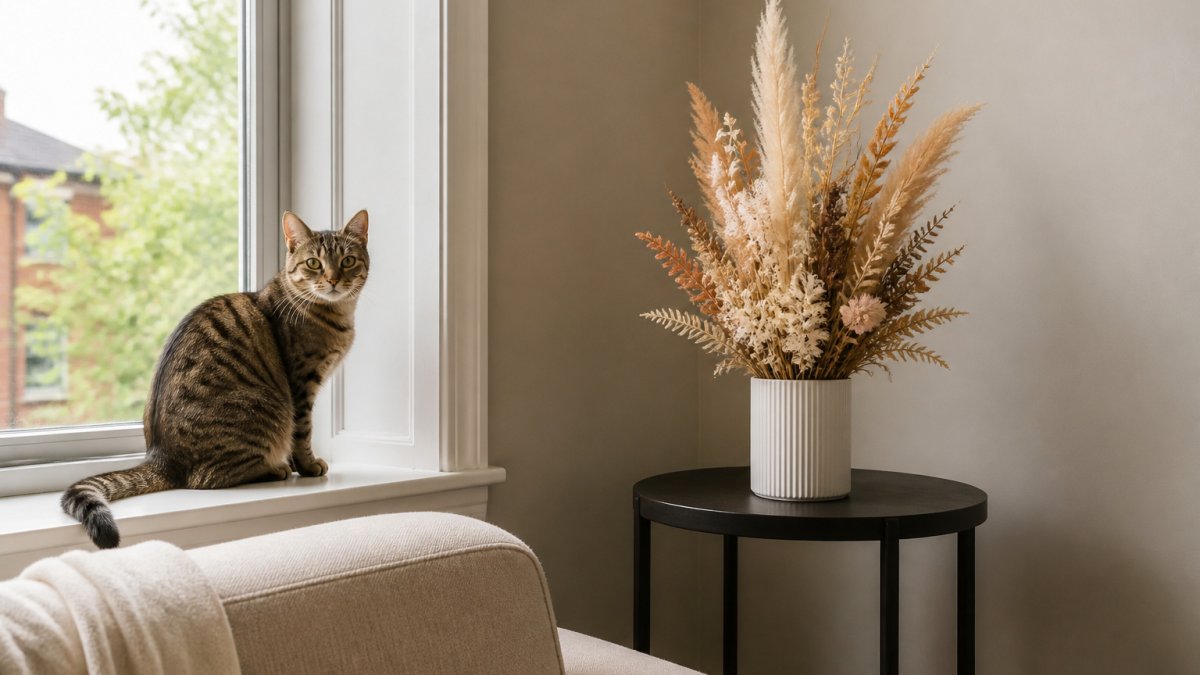
Check your arrangement regularly. Remove any petals or stems that fall. Replace damaged pieces so pets are less tempted to chew.
Watch how your pet reacts. Curiosity is normal, but repeated chewing signals that the arrangement needs a new spot or a different design.
Choosing a Pet-Conscious Arrangement for Your Home
If you have pets, choose arrangements built around pet-friendly materials and sturdy construction. Our preserved arrangements offer lasting beauty.
When you are ready to choose, browse our flower arrangements collection for styles that suit your home.
Our most popular preserved pieces include THE WILD ONE at $560.00 CAD, NATURAL CURLS at $255.00 CAD, RAFAELLA AU NATURE at $185.00 CAD, and KIMMY at $185.00 CAD.


Frequently Asked Questions
Are preserved flowers safe for cats and dogs?
Preserved flowers are not automatically safe. The plant species matters, but so do the preservation process and any dyes, glycerin or coatings applied afterward. Many treated stems are not designed to be eaten, and their chemical residue is not always listed. Keep preserved arrangements out of reach, check the species of each stem, and contact a veterinarian if your pet chews or swallows any part of one.
Is the dye or preservative used on preserved flowers harmful to pets?
It can be. Dyes, glycerin and other preservation chemicals may irritate the mouth or stomach, and the exact amount present is often unknown. Because manufacturers do not always disclose treatments, treat any preserved stem as a potential irritant. If you can, check the product label or ask the florist what was used before bringing an arrangement into a pet household.
What should I do if my pet chews or eats a preserved flower?
Remove the plant material from your pet's reach, note the species and roughly how much was eaten, and watch for drooling, vomiting, diarrhea, pawing at the mouth or lethargy. Contact your veterinarian promptly, and bring a sample or photo of the flower and any packaging. Do not induce vomiting unless a veterinarian instructs you to do so.
Which flowers are safe around dogs?
Before placing any arrangement in a home with pets, confirm the species of each stem and check reliable veterinary toxicology resources. When in doubt, choose arrangements that your pet cannot reach.
