
Quick Summary
The best sustainable corporate office flowers are preserved arrangements for reception and long-term displays, seasonal local blooms for events, and potted plants for a living element. Preserved pieces need no water or weekly replacement, which lowers waste and upkeep for shared workplaces.
- Preserved arrangements need no water and avoid weekly replacement, lowering waste and upkeep.
- Keep preserved flowers out of direct sunlight, since strong light fades their natural colour over time.
- Ask florists for a per-arrangement breakdown of locally grown and imported stems and shipping mode.
- Choose reusable mechanics like metal pin holders or grids instead of single-use floral foam.
- Pick a sculptural preserved piece for reception and a compact bouquet for desks and shared spaces.
Table of Contents
- 1. Preserved Floral Arrangements for Long-Lasting Office Displays
- 2. Seasonal Flowers for Offices Bought Close to Home
- 3. Locally Grown Flowers and Shorter Supply Chains
- 4. Potted Plants for Office Spaces That Keep Working
- 5. Reusable Floral Mechanics Instead of Single-Use Foam
- 6. Sculptural Preserved Pieces for Reception and Lobby Areas
- 7. Compact Preserved Bouquets for Desks and Shared Spaces
- Frequently Asked Questions
Why Sustainability Matters for Office Flowers
Corporate office flowers are one of the few workplace purchases that touch every employee, client and visitor every day. For more on the subject, see our article on corporate arrangements for offices. For a corporate office, that makes the choice of arrangement part of the workplace experience, not just decor. Office managers often ask which flowers look polished in a boardroom or reception area without creating waste, extra cost or upkeep every week?
Sustainability is a sensible way to answer that question. Sustainable floral choices usually mean fewer single-use materials, shorter supply chains and arrangements that last longer. Those three factors affect cost, appearance and environmental footprint at the same time.
This guide covers seven sustainable floral options for corporate offices, from long-lasting preserved pieces to potted plants that keep working after the delivery van leaves. Each option is compared on maintenance, workplace suitability and how it fits a shared space.
Quick Picks:
- Best for long-lasting displays: Preserved arrangements such as the Natural Curls or Purity designs
- Best for desks and shared spaces: Compact preserved bouquets such as the Bebe or Sable
- Best for reception statements: Sculptural preserved pieces such as The Wild One
1. Preserved Floral Arrangements for Long-Lasting Office Displays
Preserved arrangements are a practical option for many offices because they do not need water and do not require weekly replacement. Browse our preserved bouquets collection to find one for your space. A preserved arrangement uses plant material that has been treated to keep its shape and colour, so it can stay in place for a long time.
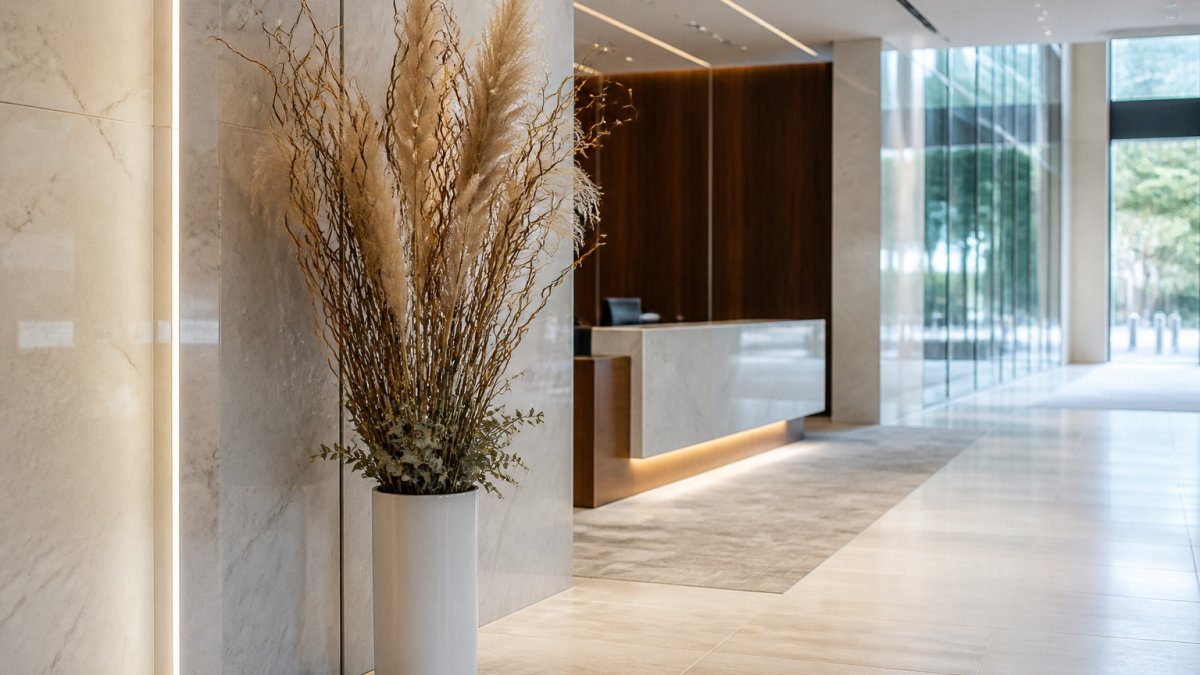
Our Natural Curls arrangement combines pampas, everlasting roses, curly willow, eucalyptus and preserved palmetto leaves in a white ceramic vase, standing 36 inches tall. At $255.00 CAD, it suits a reception desk or lobby where a single strong piece is needed. The Purity design, at $235.00 CAD, combines pampas, everlasting roses, curly willow, eucalyptus, preserved palmetto leaves, preserved leather leaf, gypsophila, wheat and silver dollar in a white ceramic vase, standing 36 inches tall.
Watch out: preserved materials should stay away from direct sunlight, since strong light fades natural colour over time. Place them in a spot with indirect light.
2. Seasonal Flowers for Offices Bought Close to Home
Seasonal flowers are often chosen because they match what grows well in a given period. Blooms that are in season locally generally travel a shorter distance.
For offices in the Montreal area, seasonal orders make sense through the year, but the mix changes. A spring order may look very different from a late-autumn one. A florist who plans around the season can help keep arrangements fresh.
Browse our fresh bouquet collection to order blooms for a lobby, meeting room or client appreciation event.
3. Locally Grown Flowers and Shorter Supply Chains
Local sourcing can lower the environmental cost of corporate office flowers, but the term is used loosely. Shorter supply chains mean fewer kilometres in transit and less time between harvest and delivery, which also helps flowers last longer in the office. The practical question for an office manager is not whether a florist says "local" but how much of a given arrangement was actually grown nearby and when.
In much of Canada, local cut-flower supply is seasonal. A common pattern is that outdoor-grown blooms peak from late spring through early fall, while winter and early spring orders rely more on greenhouse production or imported stems. That does not make off-season orders inherently unsustainable, but it changes the trade-offs: greenhouse production can carry energy costs, and imports add transport distance. A florist who plans around the season can tell you which items are at their natural peak and which are being forced or shipped in.
When you evaluate a supplier, ask for specifics rather than a general claim:
- Origin by stem: Which flowers in the arrangement were grown in the province or region, and which were imported?
- Distance and mode: Roughly how far did the imported stems travel, and were they shipped by air or ground? Air freight carries a much higher emissions cost per stem.
- Seasonality: Is this arrangement built around what is currently in season, or does it rely on out-of-season stems?
- Growing practices: Does the grower use integrated pest management, certified sustainable methods, or open-field production?
- Consistency: Can the florist repeat the same sourcing standard for a recurring office account, not just a one-time order?
For offices in colder regions, a realistic approach is to combine local seasonal blooms with preserved or long-lasting materials when the local season is short. That keeps arrangements fresh-looking while reducing the frequency of replacement orders and the transport emissions that come with them.
Local sourcing also interacts with waste. Flowers that travel shorter distances arrive fresher and typically last longer in the vase, which means fewer replacement orders and less organic waste over a contract term. For a recurring office account, that difference compounds month after month.
The article's supplier checklist can be summarised as a quick set of questions to ask a florist, along with the sourcing detail each one reveals.
| Question to ask | What it reveals | Why it matters |
|---|---|---|
| Origin by stem | Which flowers were grown locally and which imported | Shows how local the arrangement really is |
| Distance and mode | How far imports travelled and by air or ground | Air freight has a much higher emissions cost |
| Seasonality | Whether the design uses in-season or out-of-season stems | Off-season stems rely on greenhouses or imports |
| Growing practices | Integrated pest management, certified methods or open-field | Indicates how the flowers were produced |
| Consistency | Whether the same standard applies to recurring orders | Keeps sourcing standards steady over a contract |
4. Potted Plants for Office Spaces That Keep Working
Potted plants are a strong choice for offices that want something living. A healthy plant can improve the feel of a workspace for years with simple care. The trade-off is that plants need light, water and attention, so they suit offices with someone responsible for basic upkeep. Integrating these living elements alongside other workspace decor ideas helps create a balanced environment that supports both aesthetic appeal and employee well-being.
The Succulent Extra Large plant, priced at $48.00 CAD, is available from our shop. Succulents generally need less water than many office plants.
Plants can be moved, repotted or refreshed over time, unlike a one-time arrangement.
5. Reusable Floral Mechanics Instead of Single-Use Foam
Floral foam is common in arrangements because it holds stems in place and keeps them hydrated, but it is not biodegradable and is difficult to recycle. It also breaks down into particles that can enter drains and waterways. For an office with a recurring floral contract, foam-based arrangements generate a steady stream of non-recyclable waste that adds up over a year.
Reusable mechanics solve the same design problem without that waste. Common alternatives include:
- Metal pin holders (kenzan): Reusable indefinitely, suited to shallow vessels and sculptural designs.
- Glass vessels with grids or tape grids: The grid supports stems while the vessel is cleaned and reused.
- Weighted containers and river stones: Hold stems in place and can be washed and reused.
- Chicken wire or mesh supports: Inexpensive, reusable, and easy to clean between arrangements.
- Natural mechanics: Twigs, branches, and moss can support stems and are compostable at end of life, depending on local disposal rules.
For corporate buyers, the key question is what happens to the arrangement after its display life. A well-designed arrangement can be taken apart, the vessel and mechanics cleaned, and the components reused for the next event or rotation. That reduces both material cost and waste.
Ask your florist these questions before signing a recurring contract:
- Which mechanics are used in each arrangement, and are they reusable?
- Can the vessel and mechanics be returned, refilled, or reused on the next order?
- Are stems and natural materials composted or landfilled after removal?
- Is foam used anywhere in the design, including as a hidden base?
Reusable mechanics also affect cost. A vessel-and-mechanic system purchased once can be refilled with fresh stems repeatedly, which lowers the per-order material cost compared with foam-based designs that are discarded each time. For offices that order regularly, that shift is both an environmental and a budget improvement.
6. Sculptural Preserved Pieces for Reception and Lobby Areas
Reception areas need one piece that makes an immediate impression. Sculptural preserved designs work well here because their shape and height hold up without daily attention.
The Wild One is a preserved arrangement of pampas, everlasting roses, curly willow and silk white delphinium in a glass vase, measuring 72 inches tall. At $560.00 CAD, it is a premium option for a lobby or boardroom entrance.
Choose a sculptural piece when the goal is a focal point. For smaller areas, a compact arrangement may be a better fit.
7. Compact Preserved Bouquets for Desks and Shared Spaces
Desks, kitchens and shared meeting spaces need smaller arrangements that do not take up much room. Compact preserved bouquets offer colour and texture without the upkeep of fresh flowers.
The Bebe bouquet is a tied mini arrangement of bunny tail, everlasting roses, pussy willow, bleached ruscus and pampas, priced at $60.00 CAD. The Sable bouquet, also $60.00 CAD, uses bunny tail, everlasting roses, preserved palmetto leaves and pampas.
Compact bouquets can be replaced or rotated to change the look of a space. For sizes, prices and care, see our preserved flower boxes for home office desks guide.
Choosing the right sustainable flowers for a corporate office comes down to location, upkeep and how long the arrangement needs to last. Preserved pieces suit reception areas and long-term displays, fresh seasonal flowers work well for events, and potted plants give an office a living element that grows over time. Luluthia Design Inc can help you explore the right option for your space. Start by browsing our preserved and fresh collections to see which styles fit your workplace.
Frequently Asked Questions
What flowers are best for an office?
The best choice depends on the space. Preserved arrangements such as Natural Curls ($255.00) or Purity ($235.00) need no water and no weekly replacement, which suits reception desks and lobbies. Seasonal fresh flowers work well for boardrooms and client events where a fresh look matters. Potted plants suit spaces with daylight. Match the arrangement to how much light, care and attention the room can realistically provide.
How can corporate flowers be more sustainable?
Start with longevity. A preserved arrangement can stay in place much longer than fresh flowers, which often need replacing every one to two weeks. Choose seasonal, locally grown flowers to shorten transport. Ask for reusable mechanics in place of floral foam, and plan for the arrangement to be collected or composted at the end of its life. Each of these steps reduces waste across a full year of office displays.
Are locally grown flowers more sustainable?
Often, yes. Shorter transport distances generally lower the emissions linked to delivery, and seasonal local flowers avoid energy-intensive greenhouse growing. The gain is not automatic, though. Ask your supplier how the flowers were grown and delivered before assuming a lower footprint.
How often should office flowers be replaced?
Fresh arrangements usually need replacing every one to two weeks, depending on the flowers and the room temperature. Preserved arrangements such as Virginie ($185.00) or Kimmy ($185.00) can stay in place much longer than fresh flowers. Choosing preserved pieces for high-visibility spots and fresh flowers for short events keeps both cost and waste under control.
