
Table of Contents
- Why 2026 Is the Year of the Artistic Floral Centerpiece
- Modern Floral Centerpiece Ideas: 7 Artistic Designs to Try
- Seasonal Flower Centerpiece Ideas for Every Time of Year
- Dining Table Flower Arrangements: Getting the Scale Right
- Sustainable Floral Design: Foam-Free and Reusable Approaches
- Budget Tiers and Cost-Saving Substitutions
- Care, Setup Timing, and Longevity
- Conclusion
- Frequently Asked Questions
Last Updated: October 18, 2026
Why 2026 Is the Year of the Artistic Floral Centerpiece
Artistic floral centerpiece ideas in 2026 have moved past the tight, symmetrical dome. The shift is toward arrangements that read as sculpture first: exposed stems, negative space, one dramatic sweep of delphinium against a low bowl of garden roses.
At Luluthia Design Inc, we build centerpieces like a painter builds a canvas, starting with sightlines and movement before a single bloom goes in.
Loose, airy designs also use fewer stems than dense domes, keeping costs down and letting seasonal material carry the look.
Modern Floral Centerpiece Ideas: 7 Artistic Designs to Try
Modern floral centerpiece ideas for 2026 lean on creative line design, soft stone neutrals, and texture over volume. Each of the seven designs below works on a dining table, wedding table, or corporate boardroom, and each scales up or down.
Here is the quick comparison before the detail:
| Design | Key Flowers | Container | Best For | Approx. Stem Count |
|---|---|---|---|---|
| Sculptural line | Delphinium, liatris, roses | Tall cylinder vase | Entry tables, long tables | 8-12 |
| Soft stone neutral | Garden roses, lisianthus, hydrangea | Low ceramic bowl | Dining rooms, weddings | 12-18 |
| No-vase seamless | Roses, spray roses, orchids | Floral foam-free base | Low conversation tables | 15-20 |
| Bold accent | Carnations, roses, stock | Matte black or stone vessel | Modern interiors, events | 10-14 |
| Garden-inspired | Tulips, peonies, garden roses | Footed compote | Spring and summer tables | 15-22 |
| Bud vase cluster | Single stems, succulents | 5-9 bud vases | Long narrow tables | 5-9 |
| Metallic accent | Calla lilies, roses, lisianthus | Brushed metal vessel | Evening events, holidays | 10-14 |
1. The Sculptural Line Design
Start with a tall, narrow vessel and one dominant vertical flower. Delphinium or liatris gives the clean architectural line; two or three roses at the base anchor it. Leave the gap empty, negative space is the whole point.
2. The Soft Stone Neutral Palette
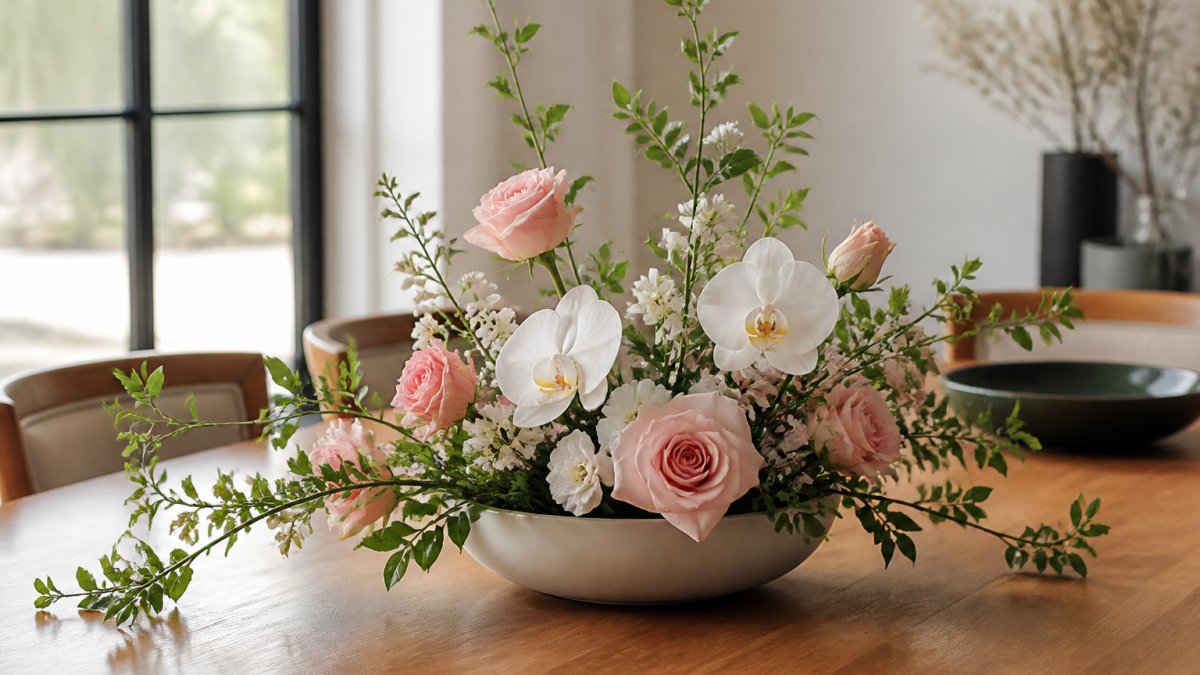
Soft stone neutrals define 2026: blush garden roses, cream lisianthus, sage foliage, and a whisper of dusty hydrangea in a low ceramic bowl. Keep it wide and shallow so guests can see across the table.
3. The Seamless No-Vase Centerpiece
A seamless centerpiece hides its mechanics so blooms appear to rest directly on the table. Our The Blossom Centrepiece uses a no-vase base with roses, spray roses, hydrangeas, orchids, and designer greens, ideal for low conversation tables where a tall vase would block sightlines.

4. The Bold Accent Color Statement
One saturated accent against a neutral base reads as modern floral art. Pair deep burgundy carnations or hot pink stock with pale roses, and keep everything else quiet so the bold color stays the focal point.
5. The Garden-Inspired Mix
Garden-inspired arrangements look gathered rather than built. Combine tulips, peonies, and garden roses with loose foliage so stems fall naturally over the rim. The Garden Charm captures that just-picked mix of tulips, roses, hydrangea, mini spray roses, and matching foliage.
6. The Single-Stem Bud Vase Cluster
Cluster five to nine bud vases down a long table, each holding one stem or a small grouping. It is the most budget-friendly design here and the easiest to set up yourself, vary the heights slightly so the line feels intentional.
7. The Metallic Accent Design
Subtle metallics add warmth without shouting. A brushed brass or copper vessel with calla lilies and cream roses lifts an evening table. Keep the metallic to the container only and let delicate flower hues balance the shine.
Seasonal Flower Centerpiece Ideas for Every Time of Year
Seasonal flower centerpiece ideas work best built around what is actually available in your region that month. The table below maps Canadian growing and import cycles to specific blooms so you can plan a generous centerpiece without out-of-season premiums.
| Season | Peak Local/Imported Blooms | Design Direction | Approx. Stem Count for a Low Bowl |
|---|---|---|---|
| Late winter (Jan-Feb) | Tulips, calla lilies, orchids, evergreen foliage | Tall sculptural line or metallic accent | 10-14 |
| Early spring (Mar-Apr) | Tulips, daffodils, lisianthus, ranunculus | Garden-inspired mix with loose foliage | 15-20 |
| Late spring (May-Jun) | Peonies, garden roses, sweet peas, stock | Soft stone neutral palette | 12-18 |
| Summer (Jul-Aug) | Garden roses, delphinium, hydrangea, zinnias | Bold accent or seamless no-vase | 15-22 |
| Early autumn (Sep-Oct) | Dahlias, carnations, stock, grasses | Bold accent with rich foliage | 10-14 |
| Late autumn (Nov-Dec) | Calla lilies, orchids, amaryllis, evergreen | Metallic accent or bud vase cluster | 8-12 |
Sourcing rules that actually save money:
- Buy within two weeks of your event date. Most Canadian wholesalers restock weekly; ordering three to four weeks out forces substitutions or cold-storage blooms that open unevenly.
- Ask what came in this week, not what is on the list. Build the palette around the three or four freshest varieties and fill with greenery.
- Use imported blooms strategically. Roses, orchids, and lisianthus are available year-round but cost more in winter. Pair one imported focal flower with local seasonal filler.
Month-by-month quick guide (Canada):
- January-February: tulips and calla lilies are the most reliable value; orchids add height without bulk.
- March-April: ranunculus and lisianthus bridge late-winter tulips and early peonies.
- May-June: peony season is short, typically four to six weeks, so book early or plan a garden rose substitute.
Our designers build around availability rather than forcing an out-of-season flower, substituting an equivalent bloom when something is short, flexibility that keeps a design looking generous year-round.
Dining Table Flower Arrangements: Getting the Scale Right
Dining table flower arrangements fail most often on scale, not flower choice. These numbers cover the three table shapes you are most likely to encounter, plus the container sizes that fit them.
Round tables
- Keep the centerpiece diameter to roughly one-third of the table diameter. On a 120 cm round table, aim for a 40 cm arrangement; on a 150 cm table, up to 50 cm.
- Height should stay at or below 30 cm from tabletop to the top of the tallest bloom so guests can see across.
- A low ceramic bowl 20-25 cm wide and 8-10 cm deep holds 12-18 stems comfortably without crowding.
Rectangular tables
- A continuous low runner should leave at least 30 cm of clear table edge on each long side for place settings and serving dishes.
- For a 180 cm rectangular table, a runner of three to five bud vases spaced 25-30 cm apart reads as one line. For a 240 cm table, five to seven vases.
- If using a single low arrangement, keep it to 40-50 cm wide and centered; anything wider than 60 cm starts to crowd plates.
Banquet and long event tables
- Cluster in odd-numbered groups (three, five, or seven vessels) and repeat the cluster every 60-90 cm down the table.
- Vary heights within a cluster by 5-10 cm so the line feels intentional rather than flat.
- Leave the center 20-30 cm of a banquet table clear if guests will pass dishes family-style.
Container sizing cheat sheet
| Table shape | Table width/diameter | Recommended arrangement width | Container type |
|---|---|---|---|
| Round | 120 cm | 40 cm | Low bowl, 20-25 cm wide |
| Round | 150 cm | 45-50 cm | Low bowl or footed compote |
| Rectangular | 90-100 cm wide | 40-50 cm | Low bowl or bud vase runner |
| Banquet | 75-90 cm wide | Clusters every 60-90 cm | Bud vases or small bowls |
Measure before you order. A centerpiece that looks right in a photo can swallow a narrow table, and an undersized one disappears in a large room. Mark the footprint with painter's tape before committing to a container size, and if renting tables, confirm the actual width, banquet tables are often narrower than they appear in venue photos.
A common mistake is scaling up the flowers but not the container. A 50 cm arrangement in a 15 cm vase looks top-heavy and tips easily. Match the container width to roughly half the arrangement width for stability.
Sustainable Floral Design: Foam-Free and Reusable Approaches
Sustainable floral design in 2026 means skipping single-use floral foam and building reusable mechanics. Foam is difficult to recycle and sheds microplastic, so many designers now use chicken wire, pin holders, or reusable moss bases, which hold stems just as firmly and can be cleaned and used again.
Reusable containers matter just as much. A ceramic bowl or glass vase bought once replaces dozens of disposable bases over a year, choose vessels you actually like, since a good container is half the design.
Budget Tiers and Cost-Saving Substitutions
Three budget tiers cover most centerpiece projects. Entry: a bud vase cluster or single-stem design keeps stem counts and cost low. Mid: a fuller low bowl mixing roses and lisianthus.
Cost-saving substitutions work without cheapening the look. Our ready-made designs give you a fixed price: The Rosetta V2 at $79.00, The Michala at $79.00, and Chrystal at $100.00 for a fuller orchid and rose arrangement.


Care, Setup Timing, and Longevity
Fresh-cut flowers last longest when you cut stems at an angle, strip leaves below the waterline, and change the water every two days. Keep arrangements out of direct sun and away from heating vents.
For anyone who wants the look without the weekly upkeep, preserved arrangements hold their appearance far longer than fresh stems. That longevity is the real value, and it is why we offer both fresh and preserved collections.
Conclusion
Choosing an artistic floral centerpiece comes down to three decisions: the line you want the eye to follow, the scale your table can hold, and your budget. Get those right and the flowers become easy.
At Luluthia Design Inc, we build each centerpiece around your table, your palette, and your occasion, from seamless no-vase designs to sculptural statement pieces. Browse our fresh and preserved collections, order online, and we will deliver across Montreal, Westmount, TMR, Hampstead, and Laval.
Frequently Asked Questions
What are the floral design trends for 2026?
For 2026, the strongest trends include sculptural line designs that use negative space, soft stone neutrals with subtle metallics, bold accent colors against quiet backdrops, and garden-inspired mixes that feel gathered rather than forced. Sustainable floral design is also shaping how designers work, with foam-free mechanics and reusable containers replacing single-use materials. Seasonal flower centerpiece ideas are gaining ground too, as hosts lean toward what is fresh and available rather than imported blooms. The overall direction is artistic, textured, and personal.
How do you make a floral centerpiece look artistic?
Start with a clear focal point and let the rest of the arrangement support it. Vary the height and texture of your stems instead of clustering everything at one level, and leave some negative space so the design can breathe. Mix flower shapes, such as round roses with spiky delphinium or soft lisianthus, and let greenery trail beyond the container edge. Choosing a palette of three to four tones keeps it cohesive. The goal is movement and sightlines, not symmetry.
What flowers work best for a table centerpiece?
Roses, spray roses, hydrangeas, lisianthus, peonies, carnations, and calla lilies all hold up well in table arrangements. For height and line, use delphinium, liatris, or stock. Greenery such as eucalyptus and garden foliage adds texture and helps the design feel finished. If you want a seamless look, choose blooms that sit low and spread outward. For dining tables, keep the arrangement under 30 centimetres tall or well above eye level so guests can see each other.
How tall should a floral centerpiece be?
For a dining table, keep the centerpiece either below 30 centimetres so guests can see over it, or above roughly 75 centimetres so it clears the sightline entirely. Anything in between blocks conversation. For a buffet or console, height matters less, and a taller sculptural design can become a focal point. Measure your table and the height of seated guests before you commit to a design, especially for long rectangular tables where low, wide arrangements work best.
How long do fresh flower centerpieces last?
Most fresh flower centerpieces last five to seven days with proper care, and some blooms hold longer. Change the water every two days, trim the stems at an angle, and keep the arrangement away from direct sun and heat. Hydrangeas are thirstier than most and benefit from a fresh water top-up daily. For events, plan to set up the centerpieces the morning of or the day before, and keep them cool until the room is ready. Preserved arrangements last far longer.